
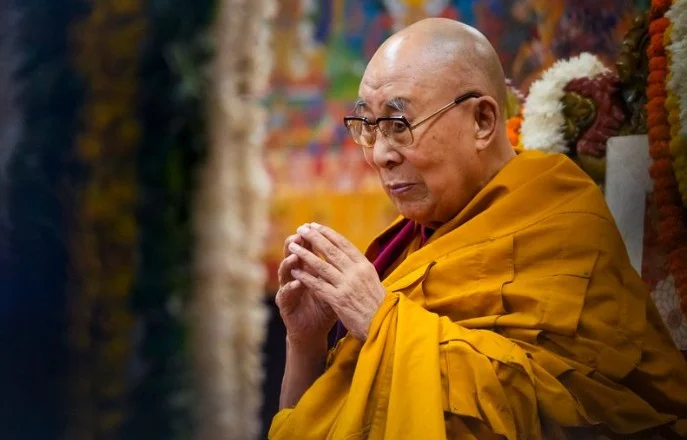
Washington, July 6 — The United States has reaffirmed its support for the Tibetan people’s right to freely choose their spiritual leader, countering China’s renewed assertion that the selection of the next Dalai Lama must follow Beijing’s approval and procedures.
The U.S. State Department, in a statement posted ahead of the 14th Dalai Lama’s 90th birthday, declared, “The U.S. remains firmly committed to promoting respect for the human rights and fundamental freedoms of Tibetans. We support efforts to preserve Tibetans’ distinct linguistic, cultural, and religious heritage, including their ability to freely choose and venerate religious leaders without interference.”
The Dalai Lama, Tenzin Gyatso, who turned 90 on July 6 (Gregorian calendar), had on July 2 confirmed that the institution of the Dalai Lama would continue and reiterated that China would have no role in the selection of his reincarnation. He stated that the responsibility lies solely with the Gaden Phodrang Trust, his spiritual office in exile.
“No one else has any such authority to interfere in this matter,” the Dalai Lama’s office said in a statement. His announcement triggered an immediate response from China, intensifying an already fraught debate over religious sovereignty in the Tibetan region.
Rejecting the Dalai Lama’s stance, Chinese Foreign Ministry spokesperson Mao Ning said any future reincarnation must comply with “domestic recognition,” the centuries-old “Golden Urn” process, and formal approval from Beijing — as mandated by Chinese law. “These are in line with religious tradition and the laws of the state,” she stated, adding that the 2007 Chinese regulations ban any interference by foreign individuals or entities.
Tibetan officials have strongly pushed back. Dhundup Gyalpo, Secretary at the Bureau of the Dalai Lama, dismissed the legitimacy of the “Golden Urn,” calling it a symbolic act used only once, during the selection of the 11th Dalai Lama. “China played no role in the recognition of the 14th Dalai Lama,” Gyalpo said. “In fact, Chinese officials were foreign guests at his enthronement in 1940, arriving in Tibet on visas issued by British India.”
Gyalpo further clarified that traditional Tibetan methods — particularly the dough-ball divination system — are invoked only when needed. If clear visions, signs, or specific written instructions are present, no divination is required.
He also contextualized the Golden Urn historically, noting that it emerged after the Tibet-Gurkha conflict of 1791–93, when Tibet, following assistance from Manchu forces, accepted some administrative proposals — including the urn — from Qing officials. “It was never fully embraced in Tibet and bore only passing similarity to authentic Tibetan spiritual practices,” he said.
The Dalai Lama, who fled Tibet in 1959 after a failed uprising against Chinese rule, has since led the Tibetan government-in-exile from Dharamsala, India. His succession remains a deeply symbolic and spiritual issue for millions of Tibetans, as well as a geopolitical flashpoint between China and the global community.
Last year, the U.S. Congress passed the Resolve Tibet Act, which emphasized Tibet’s distinct historical identity and called for a peaceful resolution to the Tibet-China conflict through international law and dialogue.
Marking the Dalai Lama’s birthday, the U.S. statement added: “He continues to inspire people by embodying a message of unity, peace, and compassion.”
As the succession question grows more contentious, the U.S. position signals growing resistance to China’s efforts to assert religious control over the Tibetan plateau — a stance expected to shape future diplomatic tensions in the region.
