
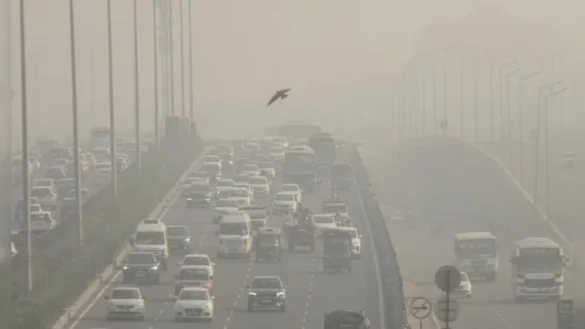
New Delhi, NOV 8 — A dense layer of smog blanketed Delhi on Saturday as the city’s air quality slipped deep into the ‘severe’ category, making it the second-most polluted city in India, according to the Central Pollution Control Board (CPCB).
The average 24-hour AQI was measured at 361, marking a sharp increase from 322 the previous day. “Delhi has entered the red zone again,” a CPCB scientist mentioned. “We are recording extremely high levels of PM2.5 and PM10 across several stations.”
CPCB’s data showed pollution levels peaking in many parts of the city: 420 at Wazirpur, 418 at Burari, 411 at Vivek Vihar, 406 at Nehru Nagar, 404 at Alipur, and 402 at ITO.
In the surrounding NCR region, Noida reported an AQI of 354, Greater Noida 336, and Ghaziabad 339 — all categorised as ‘very poor’. The rise in particulate matter has worsened visibility and health risks across the region.
According to the Decision Support System (DSS), stubble burning contributed about 30 per cent of the pollution load, while vehicle emissions made up another 15.2 per cent. Satellite data detected 100 farm fires in Punjab, 18 in Haryana, and 164 in Uttar Pradesh on Friday alone.
“The smoke from agricultural fires mixes with urban emissions, forming a thick blanket of pollutants that lingers for days,” said an environmental researcher.
Forecasts from the Air Quality Early Warning System indicate that the toxic haze will continue for the next few days, with the AQI remaining in the ‘very poor’ zone. Since Diwali, the national capital’s air quality has swung between ‘poor’ and ‘severe’ categories with little relief.
An AQI between 0 and 50 is “good,” 51 to 100 “satisfactory,” 101 to 200 “moderate,” 201 to 300 “poor,” 301 to 400 “very poor,” and 401 to 500 “severe,” as per CPCB norms.
Experts have advised Delhiites to wear masks, avoid outdoor exercise, and use air purifiers indoors. “The city’s pollution pattern is consistent with winter trends, but this year, the recovery window is getting shorter,” a health official noted.
