
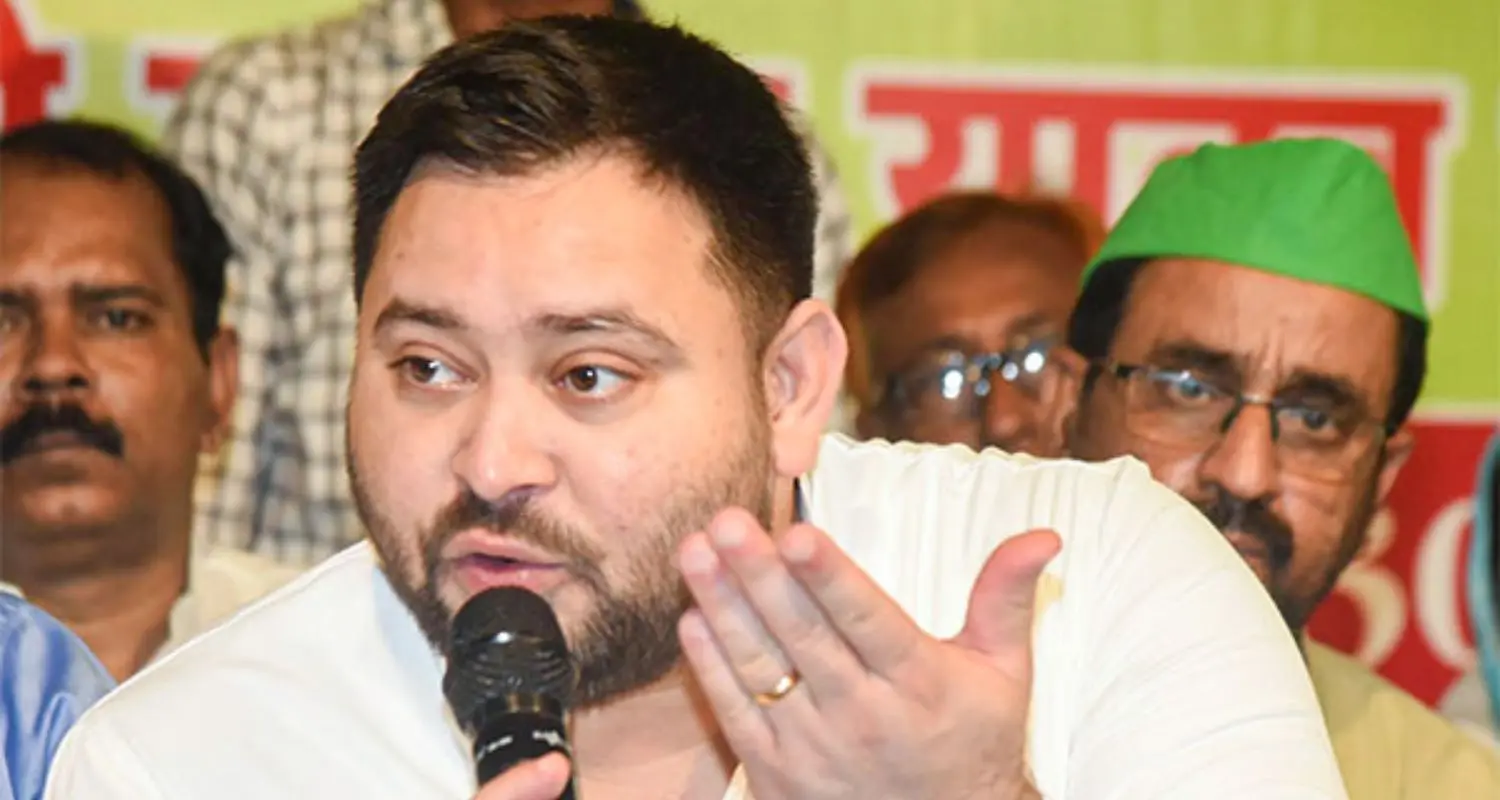
PATNA, AUGUST 19: Police intercepted a major Rashtriya Janata Dal demonstration in Patna on Wednesday, detaining opposition leader Tejashwi Yadav as party workers attempted to present a formal petition to the Bihar Governor.
The protest march gathered RJD Members of Parliament, state legislators, and senior party leaders at JP Golambar to protest the state government’s handling of youth protests and the controversial appearance of an AK-47 assault rifle during a student rally in Siwan last month. Security forces used water cannons to push back party members before taking Tejashwi Yadav into custody. Large crowds of supporters surrounded and climbed onto the police vehicle transporting the opposition leader, who was marching alongside colleagues carrying symbolic replicas of the assault rifle.
Tejashwi Yadav stated during the rally that the opposition movement would persist despite police intervention and detentions. He affirmed that the RJD would continue fighting for examination transparency, an end to paper leaks, and relief from rising youth unemployment. He maintained that the physical force used against peaceful demonstrators was ordered directly by Deputy Chief Minister Samrat Choudhary.
Participating in the march, RJD MP Misa Bharti asserted that the state government acknowledged the deployment of the AK-47 before the Supreme Court. She argued that administrative accountability must start at the top, demanding the suspension of the district magistrate responsible for permitting such force against student protesters.
The opposition campaign follows a July 25 incident in which a police officer was filmed wielding an AK-47 during a student demonstration against NEET paper leaks. While police authorities suspended the officer, opened an inquiry, and noted that standard protocol forbids live firing during public rallies, opposition leaders insist that systemic reform remains urgent.
RJD MP Manoj Jha and state legislator Alok Kumar Mehta declared that submitting a formal memorandum to the Governor is an essential constitutional step to address growing disillusionment among young voters over persistent academic scandals.
