
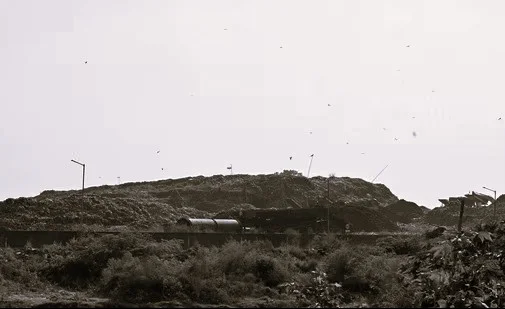
Chandigarh, Nov 3: The Chandigarh Pollution Control Committee (CPCC) has raised red flags over the city’s waste management practices, telling the National Green Tribunal (NGT) that lapses at the Dadumajra landfill worsened during the recent monsoon due to poor leachate control. Its status report, filed after site inspections, said that unusually heavy rainfall led to rainwater seeping into heaps of accumulated waste, generating hazardous leachate.
Officials found “serious deficiencies” in managing both solid waste and the resulting leachate. The committee noted that two treatment plants — one of 100 KLD capacity at the composting facility and another of 26 KLD at the new landfill — are operational, but the effluent quality remains “on the higher side.” To ease pressure, the Municipal Corporation (MC) is sending excess leachate to the Common Effluent Treatment Plant (CETP) in Baddi, Himachal Pradesh.
On July 22, 2025, the CPCC issued a notice to the MC over mismanagement at the site. The civic body, in its August 25 reply, assured compliance and listed actions such as repairing the boundary wall, constructing concrete drains to channel leachate, and relaying flooring near the wet waste plant to avoid pooling. The CPCC confirmed in its follow-up report that these measures were completed and that recent water tests from the Patiala Ki Rao choe showed no leachate contamination upstream or downstream of Chandigarh.
In its own affidavit to the NGT, the MC said that remedial steps followed two major incidents earlier this year — overflowing leachate and a fire at the landfill on May 31, 2025, caused by methane ignition. The fire was quickly contained, the report stated. “Preventive measures have been taken to avoid any recurrence, and the landfill has remained stable since July,” the MC added.
The corporation said it deployed tractor-mounted suction tankers to remove excess rainwater and leachate, diverted surplus liquid to a nearby sewage treatment plant, and directed contractors to ensure no runoff enters Patiala Ki Rao. It also highlighted ongoing bio-mining of legacy waste, delayed from May due to approvals but now expected to conclude by November 2025.
Spread across 45 acres, the Dadumajra landfill includes 20 acres that have already been bio-remediated and closed. The new landfill zone, spanning 16.72 acres, is used solely for inert waste, while adjoining processing units handle up to 400 tonnes per day of wet and mixed waste combined. The 300 TPD wet waste plant and 100 TPD mixed waste facility began operations in December 2024, the MC informed.
Officials told the tribunal that above-average rainfall during the monsoon had “temporarily stressed” the city’s waste infrastructure, but corrective and preventive mechanisms are now in place. “All future measures will focus on ensuring that leachate does not enter natural water channels,” the CPCC’s report noted.
