
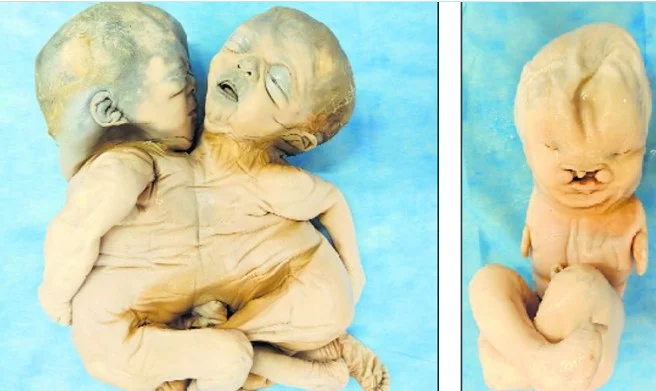
New Delhi, Sept 14 — Inside a softly lit hall at Lady Hardinge Medical College, rows of glass jars line wooden shelves, each holding fragile beginnings of life suspended in amber liquid. Some jars contain embryos barely formed, others foetuses with limbs, organs and features that never fully developed.
This is the fetal autopsy museum, where for decades doctors have preserved rare and complex specimens to teach embryology, advance genetic research and help families understand developmental conditions. “It’s not about rarity — it’s about showing real examples of how life grows, and sometimes fails to grow,” said Dr Sheetal Joshi, professor of anatomy and nodal officer for organ and body donation awareness at LHMC.
Among the collection are conjoined twins, triplets, and cases of severe malformations. Conjoined twins occur when identical embryos split late and remain fused at points like the chest or pelvis. Triplets, often linked to late pregnancies or assisted reproductive technologies, are also preserved to help study neonatal outcomes.
Other jars tell the story of devastating defects: anencephaly, where the brain and skull fail to form due to folic acid deficiency; cyclopia, in which the face develops a single eye; and phocomelia, shortened or absent limbs once caused by thalidomide. Sirenomelia, or “mermaid syndrome,” shows fused legs with underdeveloped organs. Each specimen, doctors say, helps decode how genetics, nutrition or drugs affect fetal growth.
Most of the museum’s specimens come from stillbirths or medically terminated pregnancies, donated by families after counselling. They are used not only for teaching anatomy but also for histological slides, genetic analysis and counselling future parents. “By studying these specimens, clinicians can better advise families, surgeons can learn structural patterns, and researchers can trace genetic causes that might prevent such conditions,” Dr Joshi said.
Some foetuses in the collection are more than 50 years old, preserved in formalin since British times. “Can you see this one with blond hair? It’s from that era,” said Mukesh Kumar, who has cared for the jars for 35 years.
Each jar in the room represents both scientific knowledge and human grief, offering a quiet reminder that the story of life is as much about its beginnings as its interruptions.
