
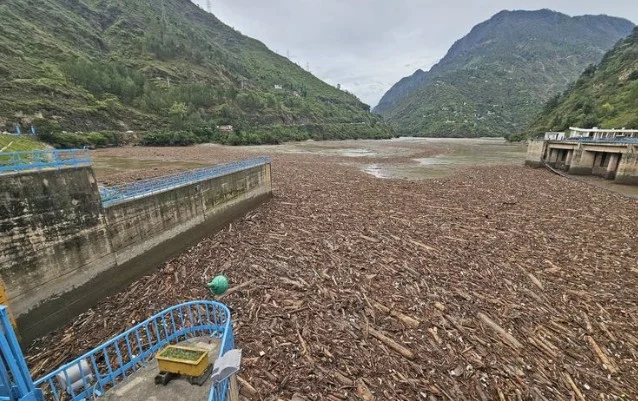
NEW DELHI, October 30 — The Himachal Pradesh government has told the Supreme Court that viral videos showing logs floating down flooded rivers were the outcome of extreme weather events, not evidence of illegal felling in the hill state.
In its affidavit filed earlier this month, Additional Chief Secretary (Forests) Kamlesh Kumar Pant said that “sudden heavy rainfall, cloudbursts, landslides, and glacier movement” triggered flash floods that uprooted large numbers of trees, carrying them downstream as driftwood. “Such incidents resulted in large-scale uprooting of trees, which were carried downstream and accumulated along riverbanks,” the government said.
Dismissing claims of organised timber felling in the Ravi and Beas catchments, the affidavit stated, “One cannot rule out stray and isolated cases of illegal felling, but the Forest Department took immediate legal action as per the law.”
On September 4, a Bench led by Chief Justice of India B.R. Gavai had issued notices to Himachal Pradesh, the Centre, and neighbouring Himalayan states after taking note of the viral videos. The court said at the time that “huge numbers of wooden logs flowing in the floods” indicated possible large-scale tree cutting and described the matter as “very serious.”
The Himachal government, however, contended that the interpretation of such visuals needed scientific context. “The videos must be understood through the lens of natural forest dynamics and disaster science,” the affidavit said. “Such debris primarily consists of naturally fallen and decaying trees mobilised by floods, not illegally cut timber.”
To verify the claims, the Forest Department formed two committees headed by the Conservators of Forests for Chamba and Kullu circles. Field inspections found 177 logs in Chamba, with none bearing marks of commercial extraction. “The presence of logs in rivers after cloudbursts is a globally observed natural process resulting from slope failures and erosion,” the report stated.
The affidavit added that most of the timber was “of low or no commercial value,” comprising driftwood, uprooted trees and biomass. “Both the inquiries indicate there has not been any large-scale or organised illegal felling,” it said, citing photographic, videographic and community testimonies.
The state also pointed out that inquiries had begun in July, even before the Supreme Court’s intervention. It urged the Bench to close the case, maintaining that its forest protection measures remain robust.
The matter stems from a PIL filed by environmentalist Anamika Rana of Panchkula, who has urged the court to frame long-term safeguards against ecological disasters in the Himalayan region, which continues to suffer recurring landslides, floods and cloudbursts. The court has sought responses from multiple states and Union ministries, including the Environment and Jal Shakti ministries, the National Disaster Management Authority, and the National Highways Authority of India.
