
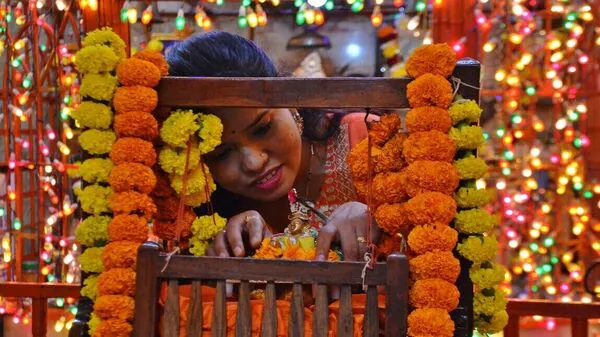
NEW DELHI, Aug. 16 — Temples, households and public spaces across India were filled with chants, music and vibrant decorations this week as Hindus celebrated Janmashtami, the festival marking the birth of Lord Krishna. The annual event, observed on the eighth day of the Hindu month of Bhadrapada, carries deep religious and cultural significance for millions of devotees.
Janmashtami is among the most widely observed Hindu festivals, drawing large gatherings at temples, community centers and cultural venues. The day is marked by fasting, night-long prayers, devotional singing and enactments of episodes from Krishna’s life. In many parts of the country, particularly in Uttar Pradesh, Gujarat, Maharashtra and Delhi, the celebrations extend over two days.
“Janmashtami is not just about rituals. It represents the triumph of good over evil and the timeless values of love, compassion and duty that Krishna’s life embodied,” said a priest at Delhi’s famous ISKCON temple, where thousands gathered for prayers.
According to Hindu tradition, Krishna was born in Mathura more than 5,000 years ago during a time of social and political turmoil. Scriptures recount that his birth occurred at midnight in a prison cell, where his parents Vasudeva and Devaki were being held by Devaki’s tyrant brother, King Kansa. Krishna is revered as the eighth incarnation of Lord Vishnu, believed to have descended to restore dharma and protect humanity from oppression.
For devotees, Janmashtami is a reminder of faith and divine protection. “Krishna’s teachings in the Bhagavad Gita guide us even today. His assurance that whenever righteousness declines, the divine will manifest to restore balance, gives people hope,” noted Professor Meenakshi Sharma, a scholar of Hindu philosophy at Banaras Hindu University.
Traditions vary across regions, but common practices include fasting, decorating homes with flowers and lights, and preparing special sweets such as makhan mishri and panjiri, foods believed to be Krishna’s favorites. Devotees often break their fast at midnight, the symbolic hour of Krishna’s birth, after performing abhishek rituals with milk, curd and honey.
In northern India, especially in Mathura and Vrindavan, towns associated with Krishna’s childhood, temples are decked with elaborate displays. Child devotees are dressed as young Krishna or Radha, and scenes from his life are enacted in plays known as Raslila.
In Maharashtra, the highlight is the Dahi Handi tradition, where teams of youths form human pyramids to break a pot of curd or butter hung high above the ground, commemorating Krishna’s playful childhood habit of stealing butter. The competitive event attracts huge crowds, with prizes offered by local organizations.
Beyond the religious context, Janmashtami has become a cultural festival that unites communities across states and even among the Indian diaspora worldwide. Temples in the United States, United Kingdom, Canada and Australia report growing participation each year, with cultural programs, devotional music and midnight feasts drawing large gatherings.
Technology has also altered the way celebrations unfold. Temples stream live prayers and rituals, enabling devotees unable to attend in person to participate virtually. Social media platforms are filled with devotional songs, verses from the Gita and messages of goodwill.
“Even if we are far from home, celebrating Janmashtami connects us with our roots,” said Anjali Patel, a student from Gujarat now living in London. “We decorate our community hall, sing bhajans and share prasad. It makes us feel close to our traditions.”
Observers note that Janmashtami is more than a religious holiday; it reinforces values of unity, resilience and devotion. By drawing people of different ages and backgrounds together in worship and festivity, the event strengthens community bonds.
Cultural experts say the festival also underscores India’s diversity. While rooted in Hindu scripture, the celebrations incorporate local music, dance and food traditions, creating variations from state to state. “In Assam, we see nam-kirtans, in Tamil Nadu there are kolams and processions, while in Maharashtra Dahi Handi has become almost a sporting spectacle,” said cultural historian Rajiv Deshpande.
At its core, Janmashtami carries a message of faith in divine justice and the pursuit of righteousness. Krishna’s role as philosopher, protector and guide remains central to Hindu belief. His teachings on selfless duty, detachment and devotion, as described in the Bhagavad Gita, continue to resonate.
For devotees like Ramesh Kumar, a shopkeeper in Mathura, the festival is about hope. “Krishna’s life reminds us that no matter how dark the times, good will prevail. That faith keeps us going,” he said, standing outside the Krishna Janmabhoomi temple as the midnight aarti began.
As the chants of Hare Krishna echoed through temples across India, Janmashtami reaffirmed its role as a festival that blends devotion, community spirit and cultural heritage. For Hindus, the celebration of Krishna’s birth remains not just a tradition, but a reaffirmation of values passed down through centuries.
