
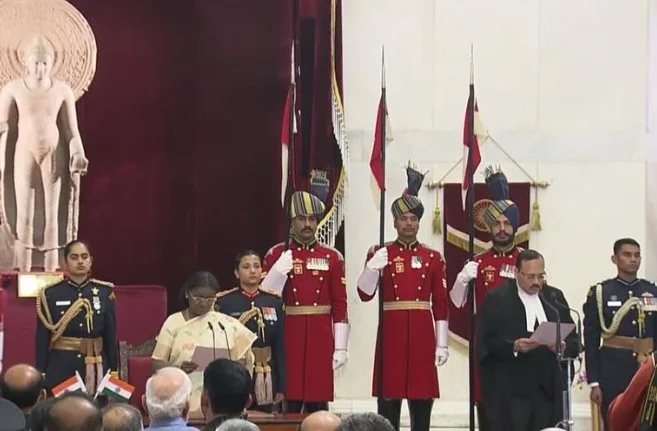
NEW DELHI, November 24 — Justice Surya Kant on Monday became the 53rd Chief Justice of India after taking the oath at the Rashtrapati Bhavan, succeeding Justice B.R. Gavai and ushering in a tenure that will run until February 2027. The ceremony began at 10 a.m., with President Droupadi Murmu administering the oath in Hindi before a gathering of senior constitutional authorities, judges and diplomats.
Justice Gavai retired on November 23, bringing to an end a brief tenure, and had recommended Justice Kant as his successor last month under the time-honoured principle of seniority. The President confirmed the appointment on October 30 in line with convention.
The swearing-in was attended by Vice-President C.P. Radhakrishnan, Prime Minister Narendra Modi, senior cabinet members, Haryana Chief Minister Nayab Singh Saini, Lok Sabha Speaker Om Birla, and sitting and former judges of the Supreme Court. Delegations from Nepal, Bhutan, Sri Lanka, Mauritius, Malaysia, Brazil and Kenya were also present.
Speaking to reporters in the run-up to his appointment, Justice Kant said tackling the judicial backlog will be his first priority. “Two things are my top priorities: arrears and mediation,” he said in a media interaction on November 22, adding that nearly 90,000 cases are pending in the Supreme Court. He noted that mediation could reduce the burden significantly. “Mediation can be a game changer,” he explained, calling for a systematic push to clear longstanding matters.
Justice Kant said he intends to move swiftly to constitute Constitution Benches so that major constitutional issues can be adjudicated, noting that such decisions could ease logjams in several high courts and lower courts.
Born in Hisar, Haryana, in 1962, Justice Kant graduated in law from Maharishi Dayanand University in 1984 before returning to academia to complete a Master’s degree in 2011 from Kurukshetra University, where he topped his class. He became the youngest Advocate General of Haryana at age 38 in 2000, and four years later was appointed to the Punjab and Haryana High Court. He went on to lead the Himachal Pradesh High Court as Chief Justice in 2018.
He joined the Supreme Court bench in May 2019, and over more than two decades in the judiciary has authored significant rulings touching on Article 370, free expression, democratic institutions, corruption probes, environmental protection and gender equality.
The seniority-based appointment tradition that guided his elevation has been ignored only twice — once in April 1973, and again in January 1977.
