
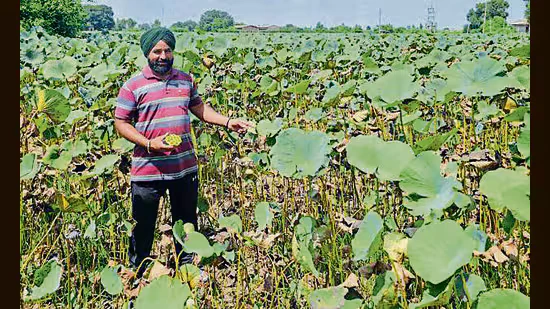
FEROZEPUR, September 15: — In the border villages of Ferozepur district, farmers are transforming waterlogged fields into lotus ponds, creating a new model of crop diversification that is yielding profits as high as ₹2 lakh per acre.
Villages such as Kunde and Barre Ke on the outskirts of Ferozepur are now dotted with lotus fields irrigated by tubewells. Farmers flood their plots with about one foot of water, which allows them to harvest three distinct products — lotus flowers, ‘bhey’ (stems) and kol dodda (seeds), which can be processed into makhana (fox nuts).
According to horticulture officer Simranjit Singh, nearly 1,200 acres in the district are under lotus cultivation. “A group of farmers are into the novel initiative of growing lotus. They have found a market to sell the produce and it is gradually picking up in the last few years,” he said.
Avtar Singh, 36, of Kunde village, is credited with introducing lotus farming in 2010. “We were facing difficulty in growing conventional crops in fields that generally remained waterlogged. I tried lotus farming on about 3 acres and the results were very encouraging. Now, I cultivate the water flower on 50 acres and earn well from it,” he said.
On average, lotus farming requires an investment of ₹80,000 per acre, with labour as the biggest expense. Farmers report yields of 50–60 quintals of lotus stem per acre. The graded stems fetch between ₹20 and ₹60 per kg, and are transported by train and road to Mumbai and other markets.
Another farmer, Hardeep Singh of Barre Ke, said the crop has become highly profitable. “A farmer can earn over ₹2 lakh per acre from lotus stems and an additional ₹35,000 from its seeds. Farmers cultivate lotus for two seasons a year. It is highly remunerative and farmers are getting attracted towards lotus cultivation,” he said.
Seasons and market demand
Major Singh, who began growing lotus in 2020, has expanded his cultivation from five acres to 25 acres, including 15 acres on lease. “Lotus is a three-month crop and it is grown twice. The first season starts in January and is harvested in March-April. Another season is parallel to paddy when the flower seeds are sown in June,” he said.
Major noted that lotus flowers see high demand during Diwali but lack proper storage or a steady local market. “Since there is no regular market for the flower or its storage facility, we allow labourers to harvest it for free as they sell it in Ludhiana,” he said. “Lotus stem is a popular vegetable in Maharashtra and other states, but it is not commonly consumed in Punjab.”
He added that lotus seeds, known as kol dodda, could generate more income if processing plants for makhana were set up locally. “Removing seeds for makhana is a labour-intensive process. We sell the raw seeds to pansari or traditional provision stores in Amritsar,” Major said.
Encouraged by consistent profits, he now plans to experiment with diverse seed varieties from Kashmir to expand production.
