
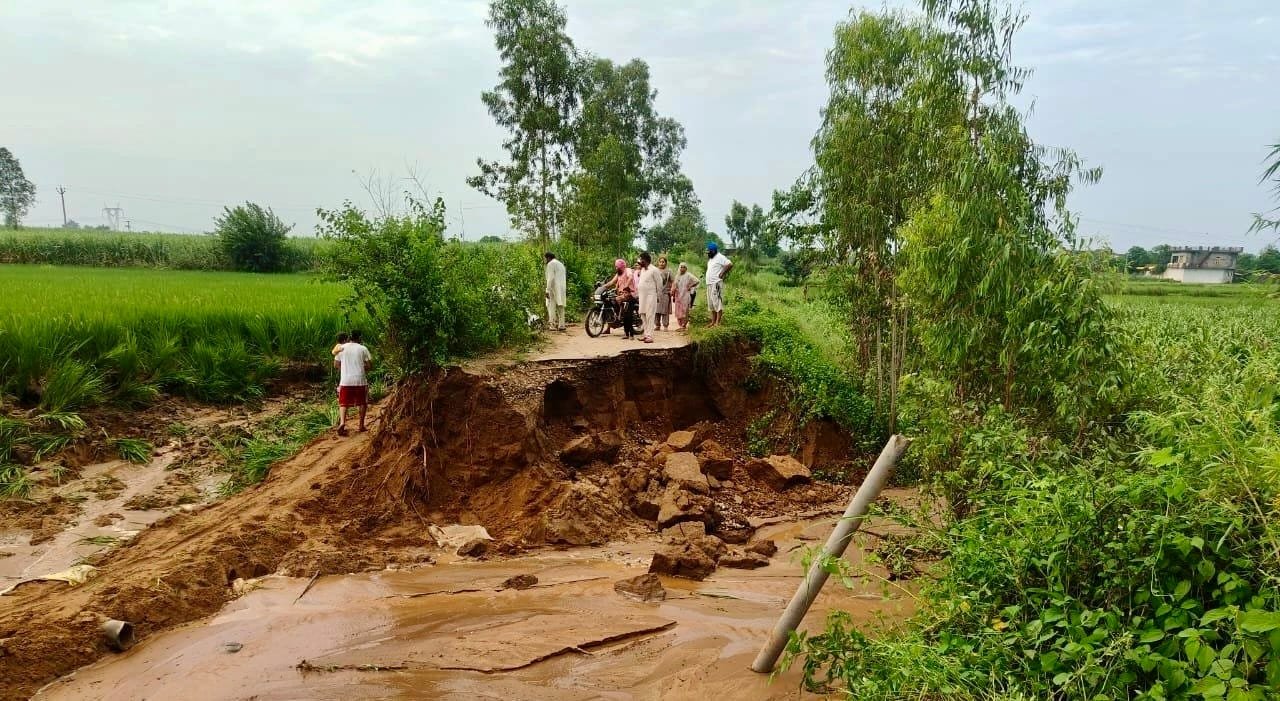
Chandigarh, November 18, 2025: Punjab’s flood-hit families continued receiving financial assistance this week as the state’s “Mission Chardikala” moved through its latest phase, transferring more than ₹35 crore directly to beneficiaries. Officials said the programme, led by Chief Minister Bhagwant Singh Mann, is designed to reach households without intermediaries and to respond swiftly to losses sustained during this year’s floods.
Relief events were organised across roughly 70 sites spanning Amritsar, Fazilka, Ferozepur, Gurdaspur, Jalandhar, Kapurthala, Hoshiarpur, Mansa, Sangrur and SBS Nagar. Over two days in the third phase alone, ₹35 crore were deposited into bank accounts, followed by an additional ₹17 crore on the fourth day. “We wanted to ensure immediate support without delay,” a senior official mentioned, emphasising the programme’s focus on direct outreach.
In Ferozepur district, MLAs Ranbir Singh Bhullar, Rajneesh Dahiya, Naresh Kataria and Fauja Singh Sarari jointly issued ₹16.68 crore to 3,000 farmers. Other districts saw similar engagement: MLA Gurdeep Singh Randhawa disbursed ₹3.71 crore to 935 families in Dera Baba Nanak; former minister Kuldeep Singh Dhaliwal distributed ₹5.86 crore to 1,330 farmers in Ajnala; and cabinet minister Harjot Singh Bains oversaw a ₹2.26 crore distribution in village Jindwari at Sri Anandpur Sahib.
Further allocations were made in Kapurthala, where residents of Bhaini Kadar Bakhsh and Passan Kadim villages received approval letters worth ₹40 lakh. Dharmkot MLA Davinderjeet Singh Laddi Dhose handed over ₹5.83 crore to 1,350 beneficiaries, while Amritsar’s Lopoke area saw SDM Sanjeev Sharma distribute ₹26 lakh. Fazilka MLA Narinderpal Singh Sawna provided ₹1.57 crore to farmers in Shah Hithar (Gulaba Bhaini). In Talwandi Sabo and Maur, Chief Whip Prof. Baljinder Kaur and MLA Sukhbir Singh Maisarkhana provided assistance to 380 affected families. Officials said the broad coverage reflects an effort to avoid leaving out any village.
Punjab has also revised its compensation structure, calling it the most extensive in the country. Payments now stand at ₹40,000 for fully damaged houses, ₹20,000 per acre for crop loss, ₹37,500 for milch animals, ₹32,000 for non-milch animals, ₹20,000 for calves and ₹100 per poultry bird. Residents said the revisions have made a noticeable difference. “We lost everything in our fields, but the money reached within three days,” a farmer said. Another villager added, “Both my buffaloes drowned, but the compensation has helped me consider buying new ones.”
Corporate contributions have supplemented state efforts, with Larsen & Toubro donating ₹5 crore and Union Bank contributing ₹2 crore. Officials described the donations as part of a transparent mechanism where each transaction is publicly recorded. “There is no scope for scams—every rupee must be traceable,” an official stated.
In a separate measure, the state introduced the “Jisda Khet, Usdi Ret” initiative, granting farmers the right to extract sand from their own fields after flooding. Officials described the step as unprecedented in India and said it aims to help farmers rehabilitate their land quickly without bureaucratic delays.
Residents across districts said the relief has brought a sense of stability after months of uncertainty. Many described Mission Chardikala as a source of renewed confidence. “It felt like someone finally reached us when we needed it,” a farmer said, reflecting the sentiment shared across several flood-hit villages.
