
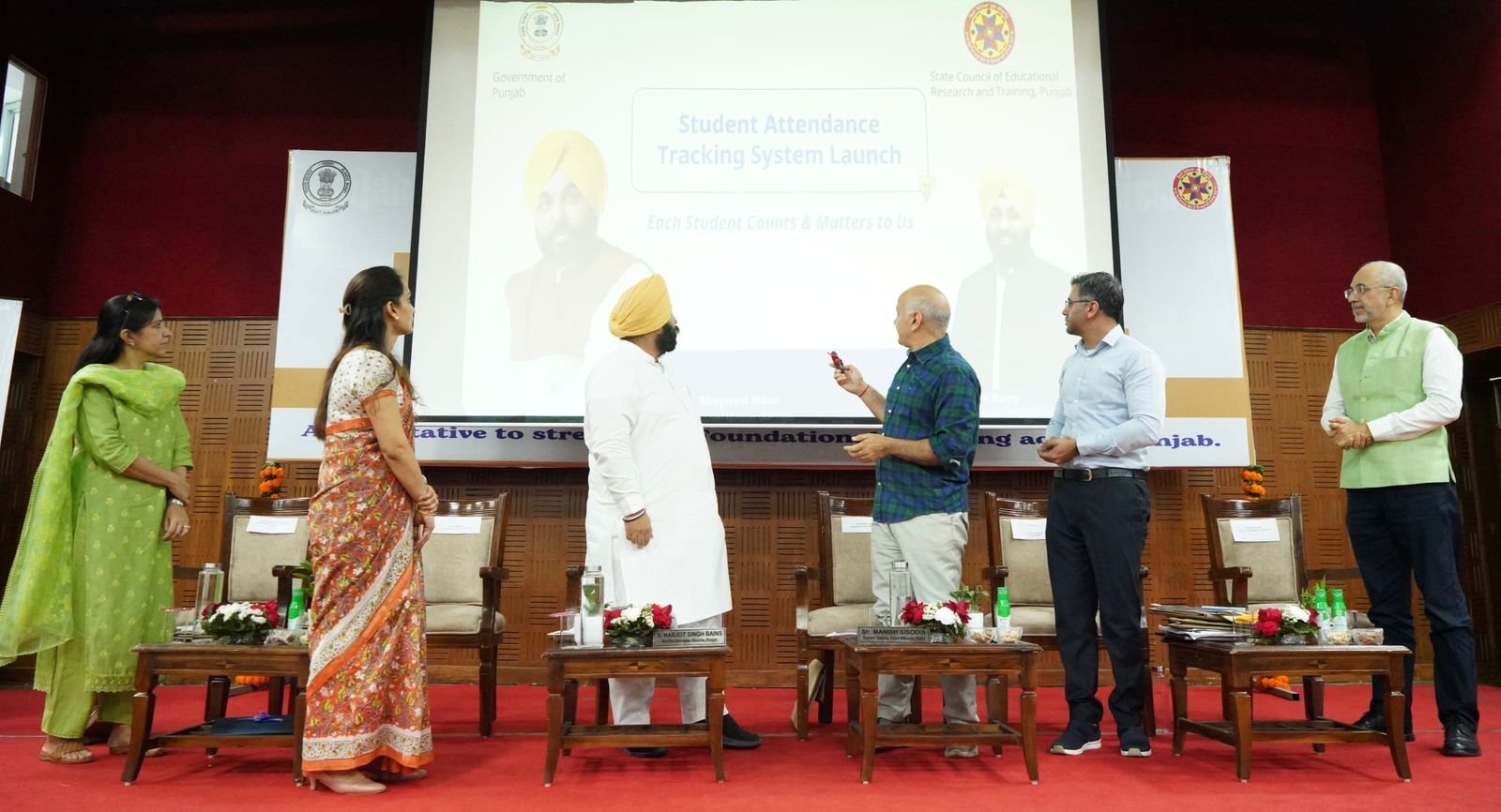
Chandigarh, April 9: The Punjab government has pushed its “Sikhya Kranti” into a new stage with the launch of Mission Samrath 2026–27, focusing on foundational literacy and numeracy through strict attendance monitoring. Education Minister Harjot Singh Bains and former Delhi Deputy CM Manish Sisodia announced on Thursday that parents will now receive daily notifications regarding their ward’s attendance to bridge the gap between schools and families.
Minister Bains affirmed that the state is leveraging its top rank in the PARAKH survey to further refine teaching quality. He stated that the level-based teaching approach, which groups students by their actual learning progress rather than their grade, has already benefited nearly 12 lakh students. “The government has ensured that funds reach the classrooms, enabling every child in grades 3 to 8 to master basic reading and mathematics,” Bains maintained. He also noted that the state is sending teachers to Finland to adopt international best practices for local classrooms.
During the launch, Manish Sisodia declared that the success of a system is measured by its ability to support the most vulnerable students. He asserted that the AAP government is the first to place the reform of government schools at the center of its political agenda. Sisodia stated that providing real-time accountability through technology is a vital step in ensuring every child remains a “hope” rather than a “statistic.”
The program is supported by a significant budgetary increase, with the allocation for education rising from ₹12,657 crore in 2021–22 to ₹19,279 crore in the current cycle. Secretary of School Education Sonali Giri stated that the department is committed to making every parent proud of the government school system. Officials maintained that the documentation and scaling of 38 teacher-led innovations will serve as the backbone for the state’s continued success in foundational learning.
