
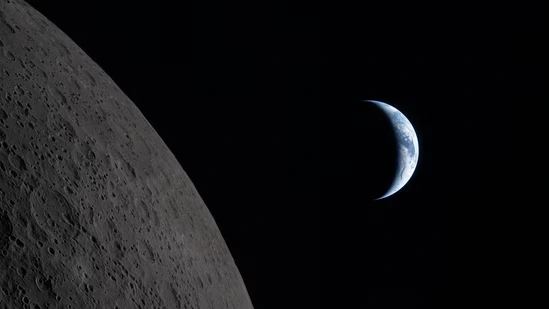
NEW DELHI, APRIL 7: A new era of lunar photography was marked on Tuesday as NASA unveiled an “Earthset” image taken by the Artemis II crew during their journey around the Moon. The photograph, which depicts Earth vanishing behind the lunar limb, serves as a modern successor to the legendary 1968 “Earthrise” shot.
The Artemis II mission, currently six days into its trek, saw the Orion spacecraft reach its farthest point from Earth at 252,756 miles. This trajectory utilized a free-return lunar maneuver similar to that of Apollo 13, though at a significantly greater distance. Canadian astronaut Jeremy Hansen affirmed the awe-inspiring nature of the view, declaring that what can be seen with the naked eye from the Moon is “just unbelievable.”
During the intensive seven-hour observation period, the crew captured images of impact craters and the lunar far side using high-powered cameras and mobile devices. The mission briefly lost contact with Mission Control as it moved behind the lunar surface, a scheduled event that allowed the astronauts to experience the Moon’s hidden side in silence. Pilot Victor Glover noted that the vantage point offered a unique perspective on the “beauty of creation,” describing Earth as an oasis in the universe.
“The Artemis II crew has completed the mission’s lunar observation period and is now beginning the return trip home,” NASA stated. The mission serves as a critical test for future lunar surface landings. With the record-breaking flyby complete, the crew is focusing on reentry procedures ahead of their planned arrival off the California coast later this week.
