
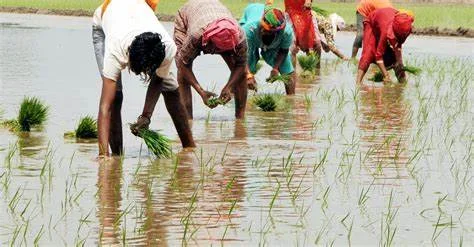
FARIDKOT, June 2 — Paddy transplantation commenced in five districts of Punjab’s Malwa region — Faridkot, Bathinda, Ferozepur, Muktsar, and Fazilka — on Sunday, June 1, following the state government’s decision to allow an earlier schedule than initially recommended.
Although the agriculture department has yet to release figures on the acreage covered on the first day, one department official remarked, “Farmers are enthusiastic about the early schedule.”
This season, paddy cultivation is expected to exceed 31 lakh hectares (76 lakh acres) across the state, marking an increase of about 2 lakh hectares over the past three years. Despite concerns over depleting groundwater levels, the area under the water-intensive crop continues to rise.
Earlier this year, Punjab Agricultural University (PAU), Ludhiana, had submitted a phased transplantation advisory aimed at conserving subsoil moisture. The university had suggested starting from June 20 in Muktsar, Faridkot, Mansa, Bathinda, Ferozepur, and Fazilka, followed by Gurdaspur, Pathankot, Amritsar, Tarn Taran, Roopnagar, SAS Nagar, and Fatehgarh Sahib from June 23, and the remaining districts from June 26.
However, in a move to appease farmer demands, the government revised the schedule. Transplantation is now permitted in the first five Malwa districts from June 1, in the second group from June 5, and in the final set of districts — including Ludhiana, Patiala, and Jalandhar — from June 9.
Direct Seeding of Rice (DSR), a water-saving method, was allowed across the state from May 15 to 31. Yet, officials noted that results from DSR have not been particularly promising this year.
While agriculture department officials assert growing interest in early sowing, PAU has voiced caution. “Farmers have begun to understand the benefits of timely, not early, transplantation,” said university officials. “Short-duration varieties developed by PAU align better with monsoon patterns and result in healthier, more sustainable crops.”
Despite advisories against long-duration, water-thirsty paddy varieties such as PUSA 44 and PR 126, many farmers continue to prefer them. These varieties are favored by rice millers for their higher output-to-yield ratios.
“Bans and advisories haven’t stopped farmers from cultivating PUSA 44. It gives better returns at the mill, and that’s a strong pull,” said a senior agriculture department official.
The divergence between scientific recommendations and ground-level decisions underscores the continued tension between environmental sustainability and short-term agricultural economics in Punjab.
