
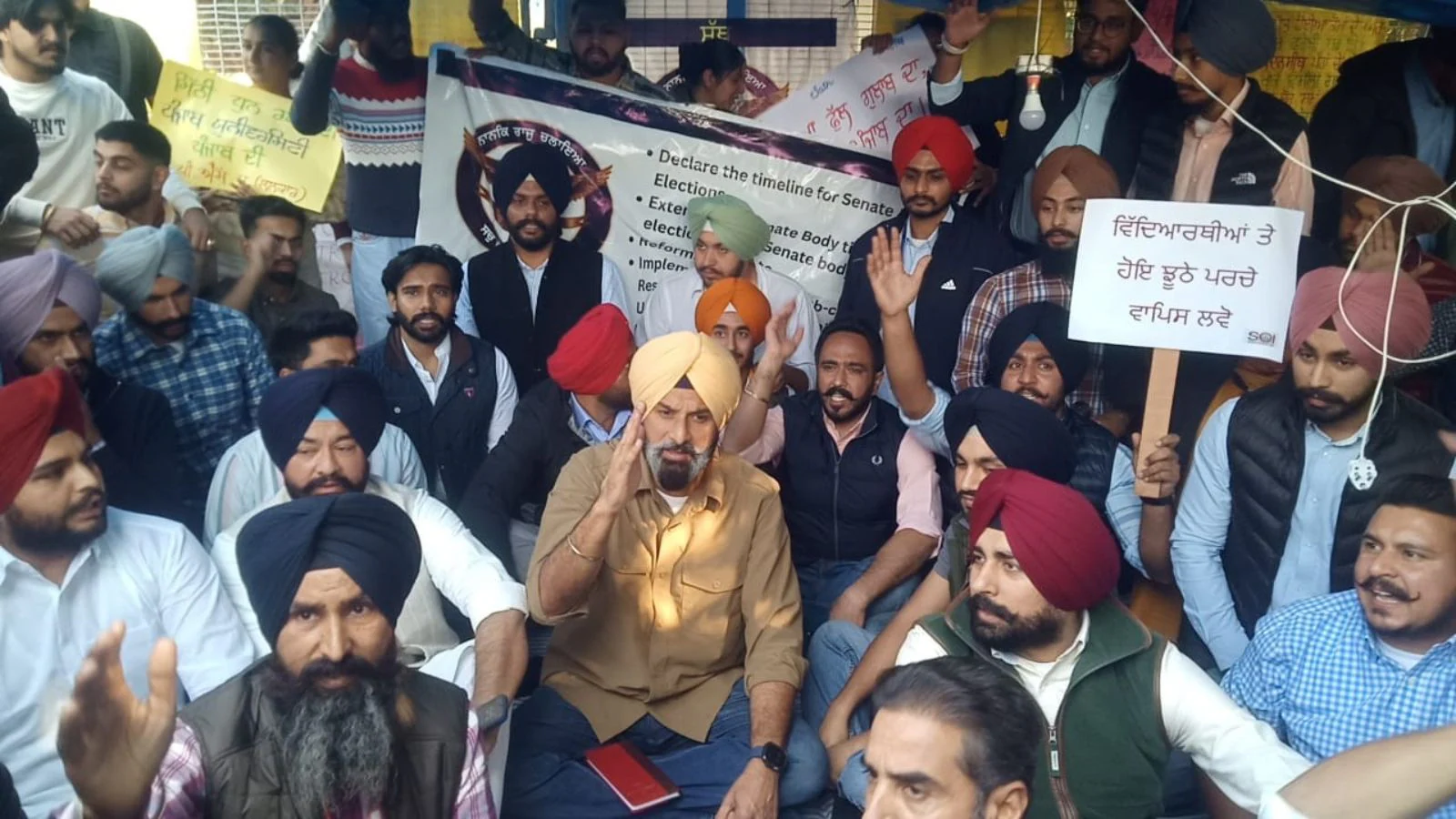
Chandigarh, November 4 — What began as a campus protest over governance changes at Panjab University (PU) has erupted into a full-blown political and academic confrontation — one that now stretches from Chandigarh’s streets to Parliament’s corridors.
Students on Monday shut down Gate No. 2 of the university, blocking officials and launching an indefinite sit-in that continued into the night. Their agitation coincided with a candlelight march led by the Aam Aadmi Party’s Chandigarh unit at Sector 17 Plaza, and a ruckus inside the Municipal Corporation House, where AAP councillors tried to raise the issue before Mayor Harpreet Kaur Babla disallowed it, calling it “beyond the civic body’s mandate.”
The protests intensified after Haryana Congress MP Deepender Singh Hooda joined students on campus, alongside Punjab AAP MP Malvinder Singh Kang, former SAD MP Prem Singh Chandumajra, and BSP state president Avtar Singh Karimpuri.
Chandigarh Congress MP Manish Tewari, among the most vocal critics of the restructuring, described it as “a constitutional travesty.”
“The Panjab University Act, 1947, is a state law. The Centre cannot alter it through reorganisation,” he told The Tribune, vowing to raise the matter in Parliament.
Punjab Chief Minister Bhagwant Mann called the move “an encroachment on Punjab’s heritage and federal spirit,” while senior leaders across AAP, Congress, and SAD accused the Centre of “destroying democratic traditions.” The SGPC too termed the reconstitution “anti-Punjab.”
Yet, not everyone sees the change as regressive. Several former vice-chancellors and academics said the reforms were necessary to modernise university administration.
“It’s a very good development, long overdue,” said former VC KN Pathak. “The Centre has filled a governance vacuum,” added ex-VC Arun Grover.
Former Senator and Gurugram University VC Sanjay Kaushik called it “a thoughtful attempt to align governance with present-day academic needs.” Others, like former PUTA president Promila Pathak and law university VC Devinder Singh, said the new structure offered “more elected representation and inclusivity.”
As the standoff continues, Panjab University has become a microcosm of a larger national debate — whether central intervention is reform or overreach, and how far academic autonomy can stretch in a federal framework.
