
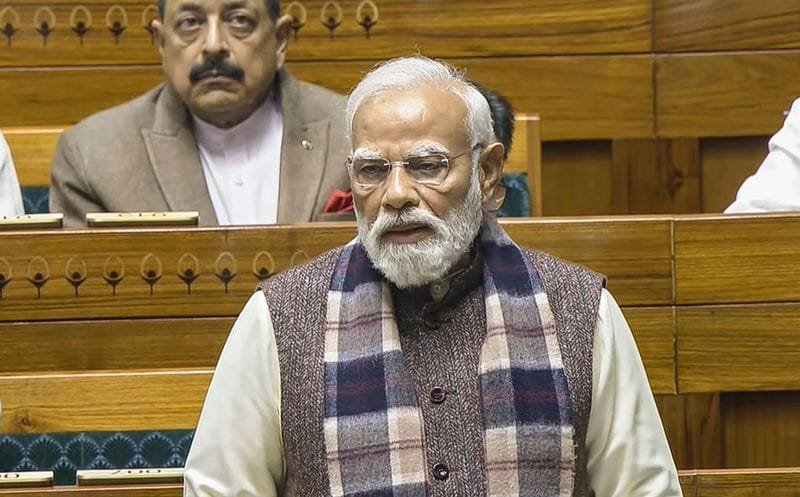
New Delhi, Dec. 8 — Prime Minister Narendra Modi on Monday drew on Mahatma Gandhi’s early writings to argue that political pressures weakened national commitment to Vande Mataram, saying the song’s unifying message had been compromised long before Independence.
Speaking during a Lok Sabha discussion on the song’s 150-year journey, Modi quoted Gandhi’s 1905 article in Indian Opinion, written from South Africa, praising Vande Mataram as “lofty,” “sweeter than the songs of other nations,” and powerful enough to inspire India’s freedom struggle. “There were forces and urges that got the better of even Gandhi’s views,” Modi said.
Modi traced the song’s origins to 1875, when Bankim Chandra Chatterjee first wrote it, and recounted how it became the emotional anthem of Bengal’s swadeshi movement. “If its sentiments were so lofty and if it bound Indians across regions, why was injustice done to the National Song?” he asked.
He said the Congress Working Committee’s 1937 decision to truncate the song — retaining only the first two stanzas while excluding those referencing Durga and other deities — fractured a unifying symbol. “The nation was shocked,” he said. “The song was shattered to pieces in the name of social harmony.”
Modi said the political dispute over Vande Mataram mirrored broader divisions that later deepened into Partition. “Under the compulsions of appeasement politics, the Congress bent then, and one day it bent again on the Partition of India,” he said.
Despite the historical disputes, Modi said the spirit of Vande Mataram continued to guide India through crises — from food shortages to wars and public health emergencies. “Whenever India has faced challenges, it has responded inspired by sentiments enshrined in Vande Mataram,” he said.
The Prime Minister urged legislators to view the National Song as a source of unity at a time when political arguments continue over its meaning. “India can brave any challenge,” he said. “We want to give strength to swadeshi, and Vande Mataram will be our mantra for national good.”
