
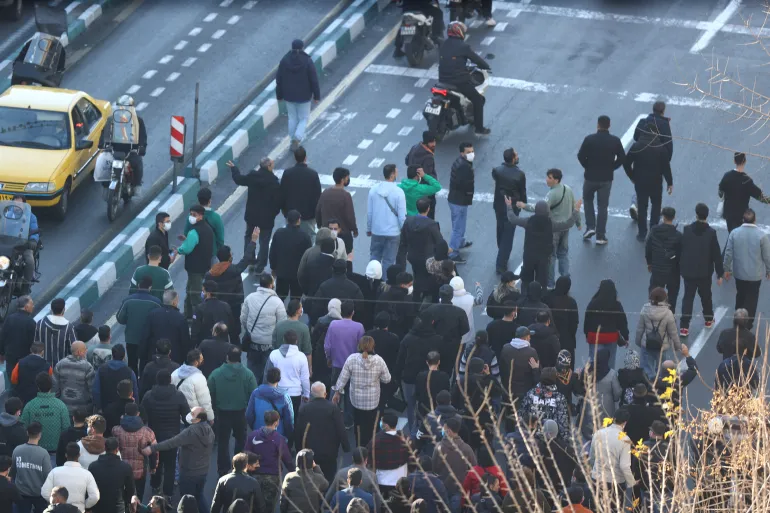
Violence linked to protests over Iran’s faltering economy has killed at least 10 people nationwide, Iranian authorities said Saturday, as demonstrations entered a second week with no sign of easing.
Two new deaths were reported overnight, raising concerns about a sharp turn toward more dangerous confrontations between protesters and security forces.
In Qom, a religious center south of Tehran, a grenade explosion killed one man, according to the government-run IRAN newspaper. Security officials alleged the man intended to use the grenade to attack others in the city.
Footage posted online showed fires burning in several streets after the explosion, though authorities did not immediately confirm the videos.
Another death occurred in the western town of Harsin, where a member of the Basij paramilitary force was killed in what officials described as a combined gun and knife attack, the newspaper said.
The unrest has spread to more than 100 cities and towns across 22 provinces, according to the Human Rights Activists News Agency, a US-based group that tracks developments in Iran.
The protests follow a steep collapse in the value of Iran’s currency, with the rial now trading at roughly 1.4 million to the dollar — a fall that has driven up prices and deepened public anger.
President Masoud Pezeshkian, a reformist, has acknowledged the severity of the crisis while suggesting the government’s options are limited. He has said the administration wants dialogue but cannot quickly reverse the economic slide.
The protests have also taken on a political tone, with demonstrators in some areas chanting against Iran’s ruling system.
On Friday, US President Donald Trump issued a warning to Tehran, saying the United States would intervene if Iranian authorities “violently kill peaceful protesters.”
The statement prompted swift backlash from Iranian officials, who threatened to target American forces in the region. No details were provided on any potential US action.
The current protests are the most widespread since 2022, when the death of Mahsa Amini after her arrest over hijab rules triggered months of demonstrations. While the present unrest has not reached the same intensity, analysts say it reflects deepening economic and political frustration.
Iran’s economy has struggled since a June war with Israel, during which the United States also struck Iranian nuclear facilities. Tehran recently announced it had stopped enriching uranium at all sites, signaling openness to renewed talks with Western powers.
However, negotiations have not resumed, as both Trump and Israeli Prime Minister Benjamin Netanyahu have warned Iran against restarting its nuclear program.
