
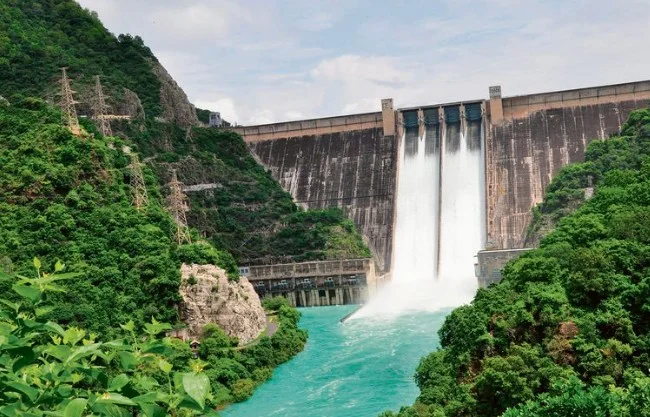
CHANDIGARH, Aug. 26 — With water levels in Punjab’s reservoirs climbing sharply after days of heavy rainfall, hydroelectric generation at Bhakra, Pong and Ranjit Sagar dams has touched an all-time high, officials said Sunday. All powerhouses at the three dams are running at maximum capacity, producing electricity at less than Re 1 per unit — the cheapest among available power sources.
According to the Punjab State Power Corporation Limited (PSPCL), the surge in water inflows from the hills has led to optimum use of turbines and round-the-clock generation. “Hydro power is being fully utilized to meet demand, and it also places the least burden on consumers compared to thermal and solar power,” a PSPCL official said.
At Ranjit Sagar Dam, all four machines generated 83.8 lakh units (LU) on Sunday, peaking at 600 MW and averaging 348 MW. Bhakra produced 329 LU, with a maximum generation of 1,428 MW and a daily average of 1,353 MW. Pong Dam’s powerhouse, with all six units operational, generated 84.5 LU, reaching 360 MW at peak and averaging 356 MW.
Reservoir levels have also risen significantly. At Ranjit Sagar, water stood at 526.78 meters (1,728.3 feet), an increase of 2.7 meters in just one day, with inflows crossing 1,01,500 cusecs compared to 16,200 cusecs a day earlier. Bhakra’s level reached 1,668.2 feet, up by one foot in 24 hours, while inflows rose from 46,400 to 59,300 cusecs. Pong climbed to 1,383.8 feet, up by 1.6 feet, with inflows more than doubling from 42,900 to 91,400 cusecs.
Officials noted that dam gates at Pong have been opened several times in recent days to release excess water, contributing to flooding downstream. While the increased hydro output is easing power supply, the high water releases continue to pose challenges in flood-hit areas.
Hydro power remains the cheapest option in Punjab, costing less than Re 1 per unit. By comparison, thermal power costs about Rs 3 per unit, while solar contracts in the state average over Rs 8 per unit. Despite this, Punjab continues to face a high overall power cost burden due to fixed charges payable to private thermal producers and reliance on loans.
