
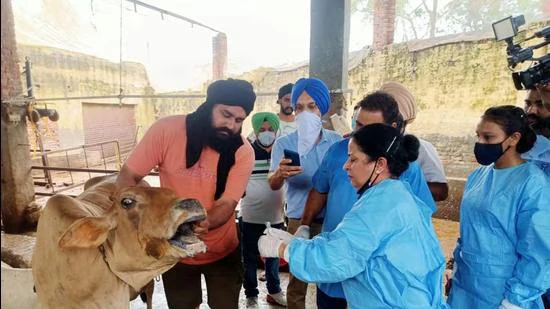
Chandigarh, Dec. 23 — From emergency flood operations to expanded veterinary infrastructure, the Punjab Animal Husbandry Department described 2025 as a year of intensive field action and systemic strengthening.
Animal Husbandry, Dairy Development and Fisheries Minister S. Gurmeet Singh Khudian said the department mounted one of its largest-ever emergency responses during floods in 12 districts, deploying 492 veterinary teams to provide 24×7 services.
“More than 3.19 lakh animals were treated free of cost. Our response combined immediate care with preventive measures to avoid disease outbreaks,” Khudian said.
To prevent Hemorrhagic Septicemia, over 2.53 lakh animals were given booster vaccinations. The department also ensured uninterrupted supply of livestock essentials, distributing over 20,000 quintals of feed, 16,000 quintals of silage, fodder and straw, along with mineral mixtures, dewormers and disinfectants. Officials organised 1,619 awareness camps to guide farmers during the crisis.
Khudian said veterinary healthcare was upgraded across the state with the procurement of 22 animal lifters and the addition of indoor patient departments at polyclinics in six districts.
Disease prevention remained a priority, with officials administering 24.27 lakh doses against Lumpy Skin Disease, 126.22 lakh doses against Foot-and-Mouth Disease and 68.88 lakh doses against Hemorrhagic Septicemia.
The Patiala Veterinary Polyclinic was equipped with a digital radiography system costing Rs 54 lakh, allowing instant imaging for fractures, bone cancers and internal conditions.
“This technology will help farmers save time and reduce treatment delays,” the minister said.
To improve livestock productivity, the department promoted sex-sorted semen technology, using 1.82 lakh doses between January 2023 and March 2025 to increase female calf births.
In fisheries, Rs 5.82 crore in subsidies was released to 187 beneficiaries during the current financial year. Fish production crossed 2 lakh tonnes, while shrimp farming expanded to nearly 1,000 acres. The department also produced 15.99 crore fish seed and trained over 9,200 people.
The dairy sector saw continued focus on skill development, with about 8,500 farmers trained annually and nearly 3,500 dairy units established each year. Insurance coverage was extended to over 30,000 milch animals under the National Livestock Mission.
Principal Secretary Rahul Bhandari said the department balanced emergency response with long-term planning.
“Our efforts this year were aimed at building a resilient rural economy through strong veterinary services, modern technology and farmer-focused schemes,” he said.
