
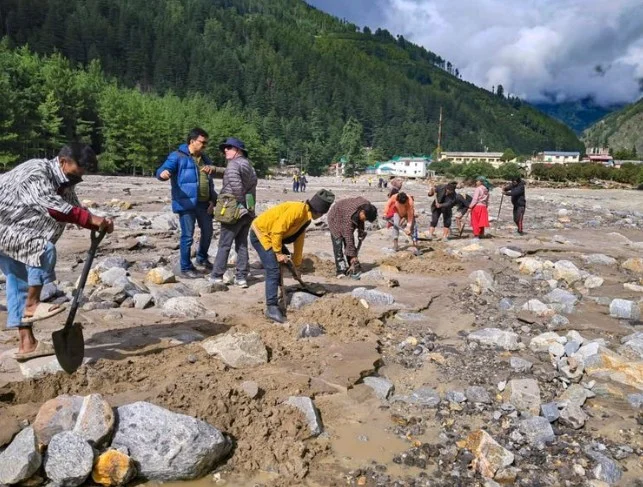
UTTARKASHI, Uttarakhand, August 16 2025 — Geological experts on Friday explained how a temporary lake formed in the Bhagirathi River following the flashfloods that struck Dharali village on August 5, causing extensive damage to the neighboring town of Harshil.
Officials said the lake, about 1,500 meters long and 12–15 feet deep, formed when heavy rainfall activated a local stream, Telgad, near an Army camp in Harshil. Debris carried by the torrent accumulated at the confluence with the Bhagirathi, creating a large fan-shaped deposit of sediment, or alluvial fan, which blocked the river’s original channel.
The flood submerged part of the national highway and a helipad, while posing a significant threat to Harshil town. The event also reshaped the river’s topography: the right-bank sand dune eroded, fresh sediment was deposited on the left bank, and partial structural damage occurred at the Army camp, including a section of the Garhwal Mandal Vikas Nigam Guest House.
“One person died, and 68 remain missing,” an official release noted. Nine Army personnel, including a junior commissioned officer and eight jawans, were also reported missing following the disaster.
A geological inspection on August 12 revealed that the saturated alluvial fan on the left bank was too weak to allow deployment of heavy machinery. Based on field data and local resources, experts devised a plan to restore partial water flow by creating small diversion channels about 9–12 inches deep.
Uttarkashi District Magistrate Prashant Arya and Inspector General (SDRF) Arun Mohan Joshi emphasized that the channels should be opened in three or four stages to avoid sudden downstream flooding.
The State Disaster Response Force (SDRF) and the Uttarkashi Irrigation Department have already begun executing the plan. Officials said careful implementation over two days has allowed controlled drainage from the temporary lake, reducing the immediate risk to downstream communities.
