
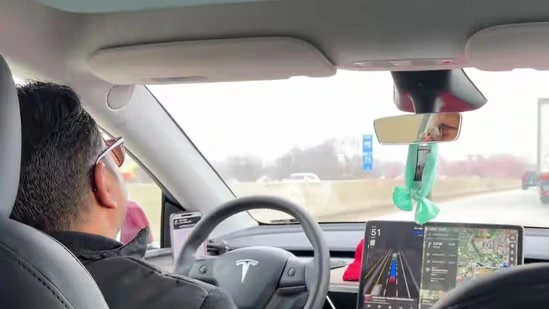
Washington, May 21: An automated ride-hail trip became the center of an international regulatory discussion after a passenger documented his Uber driver sleeping through a high-speed highway commute while relying entirely on Tesla’s driver-assist architecture.
The digital clip shows the vehicle operating autonomously on a major multi-lane highway corridor while the designated driver remains slumped over in the driver’s seat with his eyes closed. The automated navigation system successfully negotiated complex infrastructure changes and urban street transitions independently, ultimately completing the trip without a collision.
The exposure of the incident on social media platforms raised significant concerns regarding how ride-hailing corporations monitor operator alertness when using commercially available semi-autonomous software.
“The vehicle navigated the entire route and drove me to my destination all by itself,” the passenger stated in a subsequent media follow-up, confirming that the operator remained asleep for roughly 18 minutes of the 20-minute journey.
The visual evidence shows the Tesla tracking within its designated lane boundaries while its central display console tracked arrival metrics and speed variables without triggering any visible driver-alert system overrides.
The public reaction to the footage was heavily critical, with many focusing on the erratic physical dynamics that occur when a sleeping driver suddenly startles awake in a moving vehicle.
“The primary danger in these scenarios is the startle response of a human operator who awakens mid-transit,” a vehicle safety researcher remarked. “A sudden, panicked correction to the steering apparatus can easily override an automated system and cause a severe high-speed rollover.”
Corporate guidelines from both the automotive manufacturer and the ride-hailing platform state that current driving-assistance packages are not fully autonomous and require continuous, uninterrupted human supervision.
“This behavior demonstrates exactly how these systems can be dangerously misused when drivers treat convenience features as a substitute for actual piloting,” an industry critic asserted. “This specific case study will likely be used by municipal authorities to argue for a faster transition toward regulated, fully driverless fleet alternatives.”
